

 mxene academic
IF 44.6! SnSe nanosheets with Sn vacancies catalyze the production of H2O2 from water and oxygen under environmental conditions
QQ Academic Group: 1092348845
Detailed
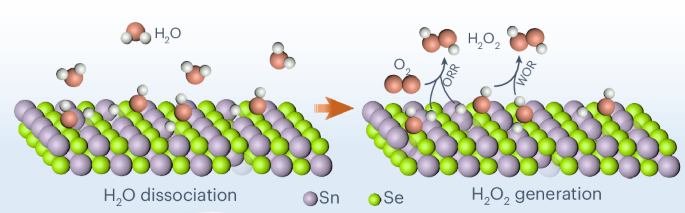
Hydrogen peroxide (H2O2) is an important industrial chemical and a sustainable energy carrier. However, achieving its simple, efficient, and cost-effective synthesis under mild conditions remains a significant challenge. Here, we demonstrate that SnSe nanosheets with Sn vacancies can directly catalyze the generation of H2O2 from H2O and O2 under ambient conditions without additional energy input (e.g., light or electricity), co-catalysts, or sacrificial reagents. This method achieves an optimal H2O2 production rate of ~2.6 mmol g⁻¹ h⁻¹ at 40°C and maintains long-term stable production (~0.3 mmol L⁻¹) in a continuous flow reactor at room temperature for more than 50 hours. Experimental and theoretical analyses indicate that this unique thermocatalytic effect arises from a dynamic process of H2O continuous dissociation and O2 molecular activation induced by Sn vacancy defects, along with the reversible surface reconstruction of SnSe nanosheets to release H2O2. Our findings provide a very simple, efficient, and completely green strategy for H2O2 production, with broader implications for other catalytic reactions involving water activation.
Innovations
1. Proposed a brand-new green synthesis route: For the first time, hydrogen peroxide was continuously synthesized at ambient temperature and pressure using only water and oxygen as raw materials, without any external energy, co-catalysts, or sacrificial agents, breaking the traditional reliance on complex conditions and noble metal catalysts.
2. Revealed a vacancy-driven dynamic catalytic mechanism: By combining experiments with theoretical calculations, the key role of Sn vacancies in promoting H₂O dissociation and O₂ activation was elucidated, and it was discovered that the catalyst surface undergoes reversible structural changes during the reaction, preventing the deactivation of active sites and enabling long-term catalytic performance.
3. Provided a new example of defect engineering in thermal catalysis applications: This study not only expands the application scope of two-dimensional chalcogenides in thermal catalysis but also offers important theoretical and practical guidance for designing high-performance non-noble metal catalysts through atomic-level vacancy regulation.
Original link
SnSe nanosheets with Sn vacancies catalyse H2O2 production from water and oxygen at ambient conditions
Pub Date : 2025-05-23 ,
DOI: 10.1038/s41929-025-01335-4
Xinyue Zhang, Yangyang Wan, Yi Wen, Yingcai Zhu, Hong Liu, Jiaxiang Qiu, Zhanpeng Zhu, Zhongti Sun, Xiang Gao, Shulin Bai, Yuqiao Zhang, Long Zhang, Xiaohong Yan, Jianming Zhang, Yong Liu, Shun Li, Li-Dong Zhao
- Previous: IF 15.7! Observing nan
- Next: Bioactive Materials |


