

 Academic Frontier
IF 26.8! A PROTAC-based copper cancer sensitizer in the treatment of lung cancer
QQ Academic Group: 1092348845
Detailed
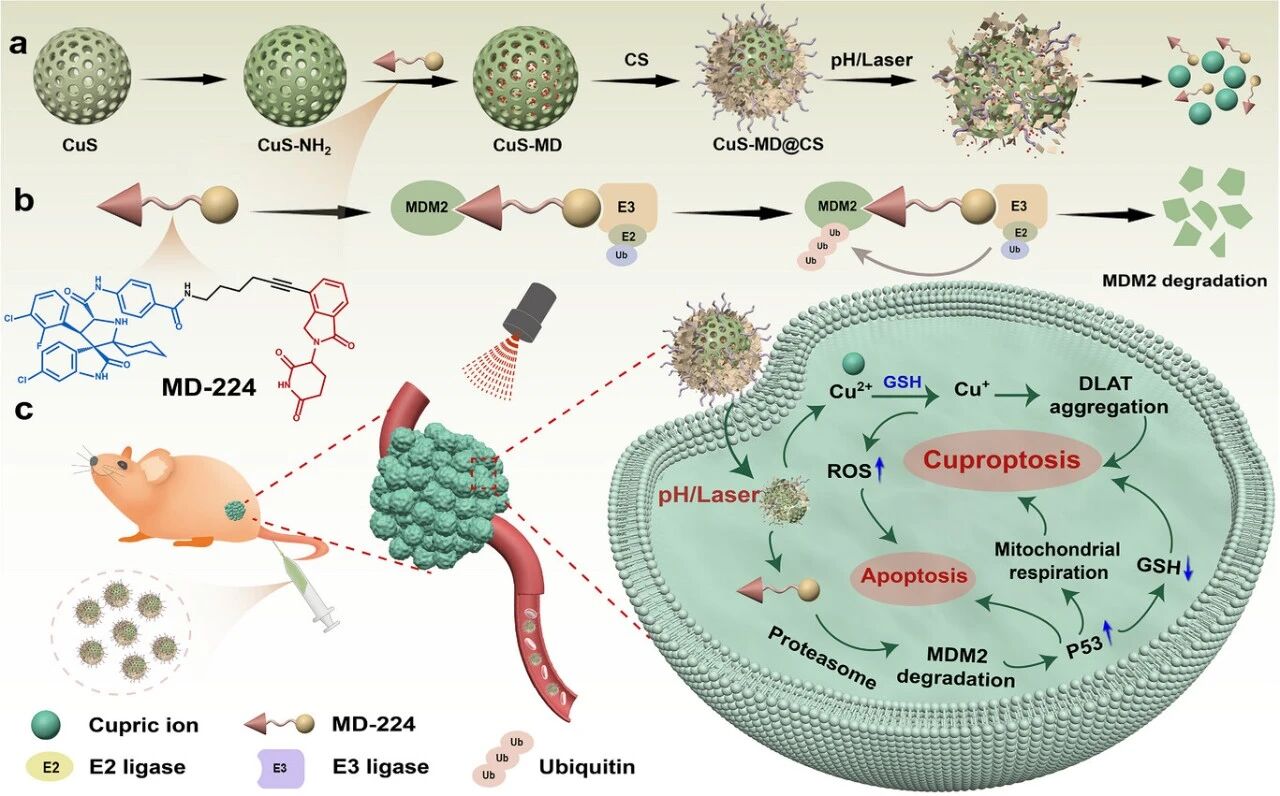
As an autonomous form of cell death regulation, cuproptosis depends on copper (Cu) and mitochondrial metabolism. However, major metabolic pathways such as glycolysis (the Warburg effect) and high glutathione (GSH) levels in tumor cells inevitably lead to poor efficacy of cuproptosis. Therefore, depleting endogenous GSH within the tumor and shifting from glycolysis to mitochondrial respiration are key factors in enhancing cuproptosis. In this study, a novel PROTAC-based cuproptosis sensitizer (CuS-MD@CS) was developed. This agent not only induces cuproptosis and reactive oxygen species production through copper ions but also modulates p53 protein expression via the ubiquitin-proteasome system in tumor cells through PROTACs, thereby achieving endogenous GSH depletion and a shift from glycolysis to mitochondrial respiration, making cancer cells more sensitive to cuproptosis. Importantly, both in vitro and in vivo experiments have confirmed that CuS-MD@CS effectively targets A549 cells and inhibits tumor growth through cuproptosis and apoptosis, showing promising therapeutic responses. The novel PROTAC-based cuproptosis sensitizer CuS-MD@CS provides a new strategy for enhancing cuproptosis and offers new hope for the effective treatment of lung cancer.
Innovation Point
1. This study innovatively developed CuS-MD@CS, a copper death sensitizer based on proteolysis-targeting chimera (PROTAC), introducing the cutting-edge protein degradation technology of PROTAC into the regulation of copper-induced cell death. It precisely controls p53 protein expression through the ubiquitin-proteasome system, thereby depleting endogenous glutathione in tumor cells and reversing the metabolic phenotype from glycolysis to mitochondrial respiration. This effectively addresses the core problem limiting the efficacy of copper-induced cell death caused by high GSH levels and the Warburg effect in tumors. 2. The design of CuS-MD@CS embodies a strategy innovation of multi-mechanism synergistic sensitization. It not only directly triggers copper-induced cell death and reactive oxygen species generation through copper ion release but also indirectly disrupts cellular metabolic balance via PROTAC-mediated dynamic degradation of the p53 protein. This bidirectional action both enhances the induction efficiency of copper-induced death and overcomes tumor metabolic adaptability, providing a path for copper death therapy that combines precision and broad-spectrum effectiveness.
Original Link
A PROTAC-Based Cuproptosis Sensitizer in Lung Cancer Therapy
Advanced Materials (IF 26.8) Pub Date: 2025-06-11 DOI: 10.1002/adma.202501435
Yu Wang, Xiaoyang Yao, Yingying Lu, Juan Ruan, Zhao Yang, Chunhui Wang, Niantong Yang, Yan Gao, Shuo Shi
- Previous: A Rising 2D Star: Nove
- Next: Bioactive Materials|离子


